History of the Château de Beynac
Arriving without a car?Every car park in the village is paid, all year, and the top one fills first in summer. A half-day tour from Sarlat drops you in the village and takes you on to Domme and the river; every option cancels free up to 24 hours before.
Check availabilityThe barons and their cliff
Beynac was built from the twelfth century by the barons of Beynac, on a spur more than a hundred and fifty metres above the Dordogne, for the reason every castle on this river exists: the valley was the road, and whoever held the height held the traffic. The square keep is the oldest part, stone replacing an earlier wooden structure. Adhémar de Beynac was lord from 1147 and died without a direct heir in 1194, which is where Richard the Lionheart and Mercadier enter the story for six years before the family took it back.
Division, reunion and the four barons
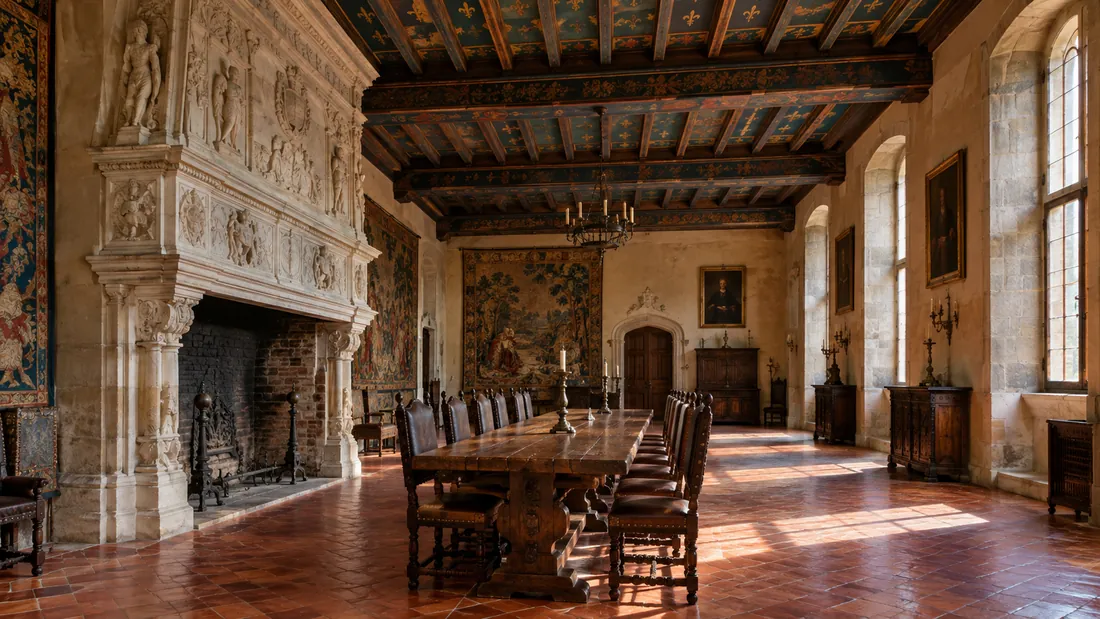
The barony was split between the brothers Gaillard and Mainard in 1241 and put back together in 1379. In the fifteenth century the great hall became the Salle des États du Périgord, where the four barons of the province — Beynac, Biron, Bourdeilles and Mareuil — met. The same room was the banqueting hall and the seigneurial court, and the Renaissance fireplace in it belongs to the period when defence stopped being the only consideration. The room, and the ones around it.
The Hundred Years War frontier
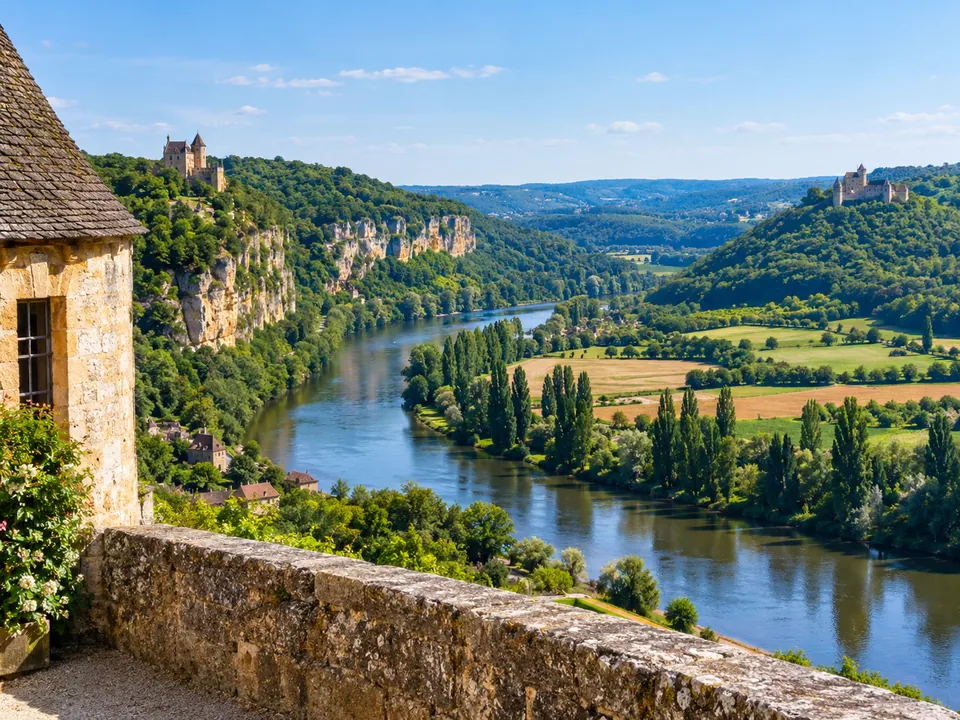
The war ran from 1337 to 1453 and the Dordogne was the frontier through much of it. Beynac held for the French crown; Castelnaud, on the far bank, held for the English. The Treaty of Brétigny in 1360 handed Beynac to the English side, a confiscation in 1368 restored French control, and the war finished in 1453 with the crown holding the valley. Popular accounts add a battle between the two castles; none is documented. The siege that is on record here is the siege of Castelnaud in 1442. The two castles, compared honestly.
The end of the line, and the twentieth century
The Beynac line ended in 1753 with Pierre, the last marquis, who had only daughters. The castle passed to the descendant family de Beaumont du Repaire, which held it until it was sold in 1961. It had been listed a monument historique on 11 February 1944, the château together with its curtain walls and terraces. In 1962 it was bought at auction by Lucien Grosso for 170,000 francs, and he set about the restoration that is the reason the rooms you walk through are furnished rather than empty. In 1999 the Grossos decided to bequeath the castle to Albéric de Montgolfier; the sourced trail stops there, and what is certain today is that Beynac is privately owned and privately run, independently of the group that operates Castelnaud and Marqueyssac. It received 125,000 visitors in 2022.
Château, or castle?
The French word château covers two things English keeps apart: the fortified castle and the grand country house. Beynac is a château fort, a fortress, built to be held and not to be admired — double walls, double moats, a barbican, a keep. It has nothing in common with the pleasure-houses of the Loire except the word. That is the whole of the distinction, and it explains why the Dordogne’s châteaux look the way they do. The other fortresses in the valley.
Walk the eight centuries yourself
Entry to the castle with commentary on your own phone, about an hour, plus the exhibition on Beynac in the time of Richard the Lionheart and Eleanor of Aquitaine. From around seventeen euros.
Frequently asked questions
How old is the Château de Beynac?
The barons of Beynac began building on the cliff in the twelfth century, and the square keep is the oldest surviving part. Later centuries added the great hall, the apartments and the barbican. What survives from when.
Who owns the Château de Beynac?
It is privately owned and privately run. It was bought at auction in 1962 by Lucien Grosso, who restored it, and in 1999 the Grossos decided to bequeath it; the documented trail stops there, so no current owner is named here.
Was there a battle between Beynac and Castelnaud?
The two held opposite banks for opposite sides in the Hundred Years War, but no battle between them is documented. The siege on record in this pair is the siege of Castelnaud in 1442.
What is the difference between a château and a castle?
In French, château covers both a fortress and a grand country house. Beynac is a château fort: walls, moats, a barbican and a keep, built to be held. Its opposite number.